The future of mobility is arriving early — chairs that drive themselves, balance themselves, stand you up, and steer hands-free. Our #1 pick is the Strutt ev¹c (CES 2026 Best of Innovation, 360° LiDAR, self-navigating waypoints). Every chair is scored 0–10 on technological innovation, real-world usefulness, and the company standing behind it — because bleeding-edge tech from a shaky company is a gamble, not a purchase.
In a hurry? These are the three most important breakthroughs — the full scored ranking follows.


Scores weight genuine technological novelty heaviest (autonomy, self-balancing, standing, novel control), then real-world usefulness, then company stability and warranty — first-generation products carry inherent risk, and we score accordingly.
Every tech-forward chair in the ranking, compared on what the technology actually does.
| Rank | Product | Weight | Range | Capacity | Motor | Battery | Score | |
|---|---|---|---|---|---|---|---|---|
| 1 | Strutt ev¹c | 147 lbs | 20 miles | 350 lbs | Quad-drive | 640Wh LFP | 9.6 | Official Product Site ↗ |
| 2 | XSTO M4 | 113.5 lbs* | 9.3–10.5 mi | 254 lbs | — | ~396Wh Li | 9.0 | Official Product Site ↗ · Amazon |
| 3 | Karman XO-505 | 298 lbs | 25 miles | 250 lbs | — | 864Wh SLA | 8.6 | Official Product Site ↗ · Amazon |
| 4 | Omeo | 154 lbs | 31 miles | 243 lbs | Dual in-wheel | ~766Wh* | 8.4 | Official Product Site ↗ |
Range figures are manufacturer-claimed. 'Self-driving' means driver-assist unless stated — the user is always responsible.
What each breakthrough does, where the technology falls short, and who should actually buy it.
The Strutt ev¹c is the most technologically ambitious power chair you can buy: dual LiDAR, cameras, time-of-flight and ultrasonic sensors fused into a 360° awareness bubble, driving four modes from collision-braking Co-Pilot to Waypoint mode that self-navigates saved routes ('take me to the kitchen') via voice command. Quad-drive motors with independent suspension handle grass, gravel and 2-inch curbs at up to 8 mph, and OTA updates keep it improving. It's validated by CES Best of Innovation, Red Dot Luminary and iF awards. The honest price of the future: $7,499, ~147 lbs, no published warranty duration, explicitly 'not a medical device' (no insurance), and first-product startup risk.
The XSTO M4's party trick is genuinely unique: an active self-balancing system that keeps the seat level on slopes and uneven ground, paired with power seat-height adjustment from 13.7 to 25.6 inches — reach counters, tables and transfer surfaces other chairs can't. Mecanum front wheels give 360° movement, the smartphone app adds Bluetooth remote control, and it one-touch folds plus splits into 3 parts for transport. At $3,999 it's the cheapest entry to novel tech here, with a US warehouse and 30-day trial. Caveats: 254 lb official capacity (dealers' '330 lb' is the M4 Pro's figure), ~113.5 lbs without battery, the 396Wh battery exceeds airline limits (travel battery sold separately), and XSTO is China-based with no US entity.
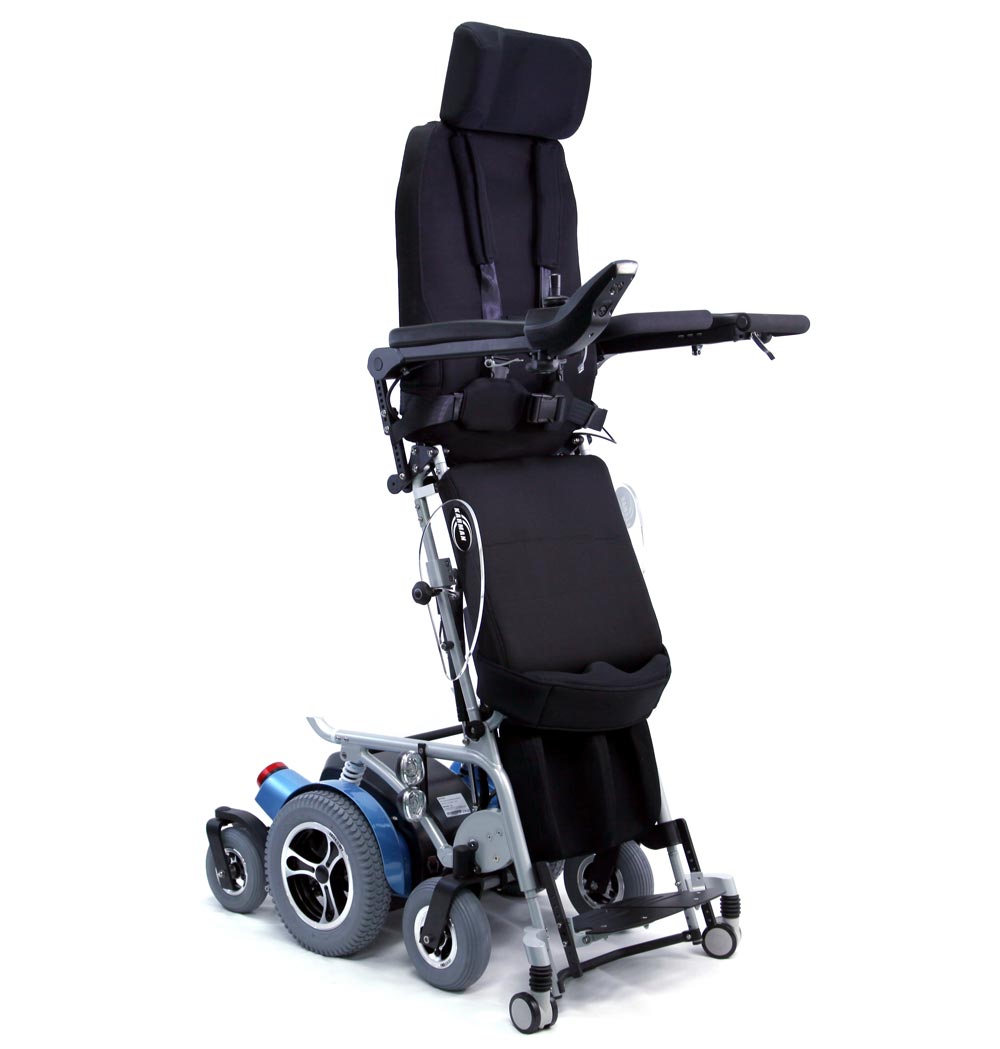
Standing changes everything — reach, circulation, bone density, eye-level conversation — and the Karman XO-505 is the only full-power standing chair genuinely purchasable online at ~$14,870. The powered hydraulic actuator takes you from recline to standing in under 14 seconds, and unlike most standing chairs it drives while standing (1 mph safety interlock). LCD memory controls, power recline/tilt/elevating leg rests, and a US company (City of Industry, CA) with a published warranty and real dealer network. The trade-offs: a mature ~2013-era design on 298 lbs of lead-acid batteries, 250 lb capacity, and 'new technology' only relative to mainstream chairs.

The Omeo is the most radical drivetrain you can buy: a self-balancing two-wheeled chair steered hands-free by shifting your core — lean to go, with joystick and seat-control modes as backup. It self-levels over bumps, parks on self-levelling legs, turns in zero degrees, climbs 20–25° inclines, hits 12 mph, and runs up to 31 miles per charge. Ten years of shipping history from New Zealand's Omeo Technology, with US sales through Omeo America (Tucson, AZ). The price of radical: $32,500, not FDA approved (no insurance), 154 lbs, a 243 lb capacity cap, hands-free control that needs core function and training — and a power base built on the discontinued Segway PT platform, which raises real long-term parts questions.
Even the Strutt ev¹c's CEO says the user is always responsible. Treat autonomy features as collision-avoidance and convenience — not a chauffeur. Blind spots (feet, glass, rain) are real.
Startup chairs can be brilliant and still risky: unpublished warranties, thin service networks, uncertain parts supply (ask Omeo about the Segway platform). Buy the tech with eyes open, and prefer companies with real support lines.
Chairs marketed as 'not a medical device' (Strutt, Omeo) have no insurance or Medicare path. Budget the full purchase price — and check whether an HSA/FSA can help.
Self-balancing is magical — unless what you actually need is range. Match the breakthrough to your daily life: standing for reach and health, autonomy for safety, app control for caregivers.
Our 2026 pick is the Strutt ev¹c: 360° LiDAR sensor fusion, AI co-pilot with collision braking, self-navigating waypoints, voice control, and OTA updates — a CES 2026 Best of Innovation winner at $7,499.
Semi-autonomous ones, yes. The Strutt ev¹c can self-navigate saved indoor routes and brake for obstacles — but the CEO himself says the user is always responsible. Think driver-assist, not robotaxi.
Usually not for the novel-tech flagships — Strutt and Omeo explicitly position outside medical-device status. FDA-cleared chairs with documented medical need (like standing chairs through DME) have the best coverage case.
It can be — check warranty terms (Strutt doesn't publish durations), service network, and parts supply before buying. Established-company tech (Karman) trades novelty for security.
The Strutt ev¹c (9.6) is our #1 for a reason: nothing else combines 360° LiDAR, genuine self-navigation, 8 mph speed, and OTA updates — it's the clearest look at where mobility is going, available today at $7,499.
If the ev¹c is too much money or too much trust in a startup, the XSTO M4 brings self-balancing novelty at nearly half the price — and the Karman and Omeo below push different frontiers.